Where the week goes: the real cost of "what's for dinner?"
August 4, 2026
Ask someone what the hardest part of feeding a household is and they'll usually say the cooking. It isn't. The cooking is the visible part. The expensive part is everything that happens before it — and most of it happens in your head.
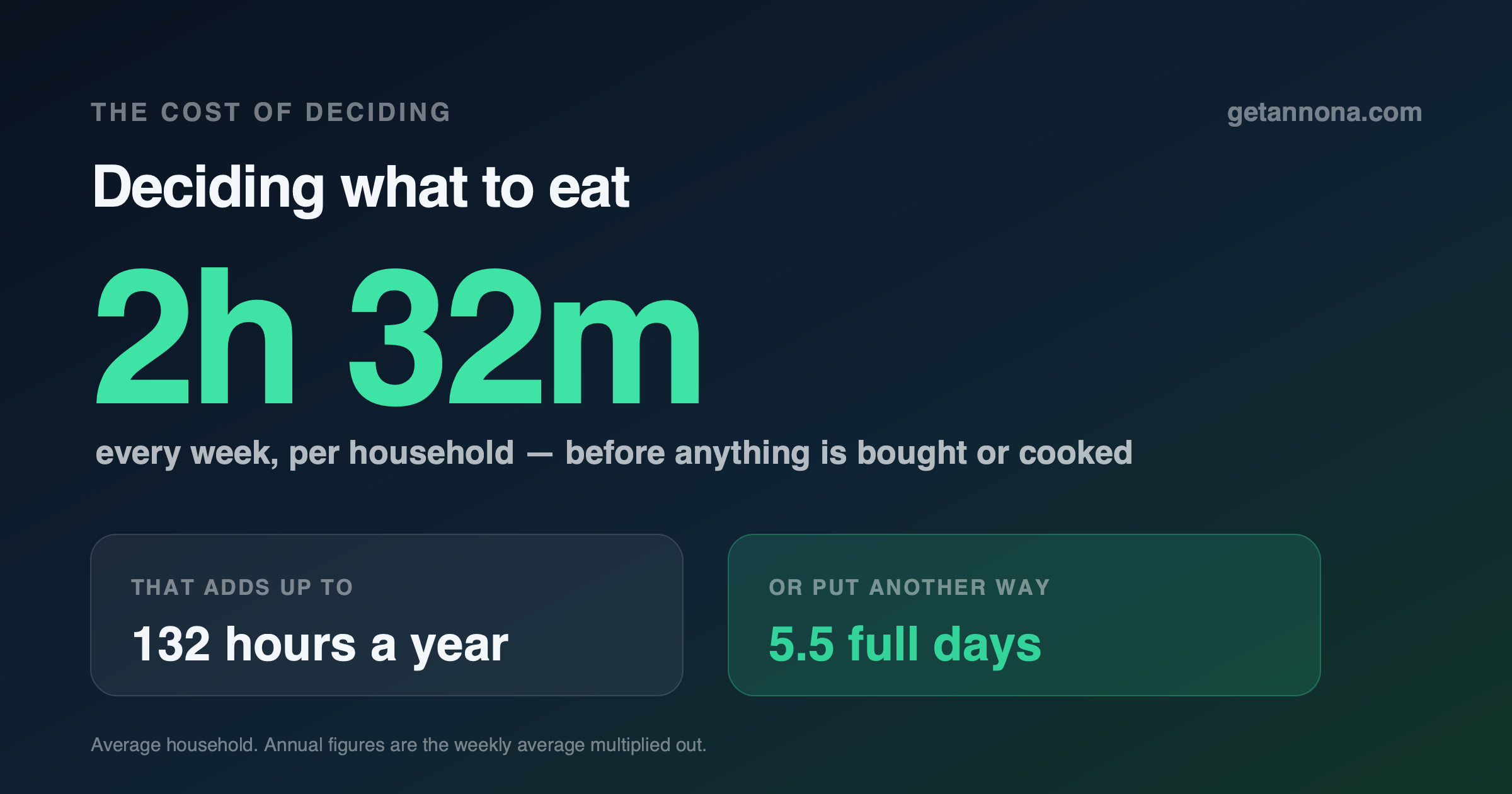
Deciding is the part nobody budgets for
Surveys of household meal habits put the average couple at roughly two and a half hours a week spent purely on deciding what to eat. Not shopping. Not chopping. Deciding. That's a full working week every year, spent staring into a fridge.
It's invisible because it never happens in one block. It's ninety seconds at 10am wondering whether the chicken is still good, four minutes in the checkout line trying to remember if you have rice, and then the big one — the 6pm stretch where everyone is hungry, nothing is defrosted, and the decision has to be made immediately by whoever has the least energy left to make it.
Why the 6pm decision is the worst one
Decision fatigue is well documented: the quality of choices degrades over a day of making them. Dinner sits at the exact worst point on that curve — the end of the day, when willpower is lowest and time pressure is highest.
This is why the same households that genuinely intend to eat well end up ordering out on a Wednesday. It isn't a failure of discipline. It's a scheduling problem: the hardest decision of the day has been placed at the hour you are least equipped to make it.
The fix isn't cooking faster. It's moving the decision to a moment when it's cheap to make — and then only making it once.
The mental load is unevenly distributed
In most households the planning isn't shared even when the cooking is. One person carries the running model of what's in the fridge, who won't eat mushrooms, what was served on Monday, and what needs using before it turns. That model is real work, and it doesn't stop when dinner is over.
That's also why "just make a meal plan" so often fails. A plan written by one person, for everyone else's tastes, from memory, on a Sunday, is a lot of work to produce and easy to abandon by Tuesday.
What actually removes the cost
Three things, in order of how much time they give back:
- Decide once, for the whole week. Batching the decision removes six of the seven 6pm negotiations. The week is settled while you're calm.
- Let the plan know who's eating. A plan that already accounts for everyone's tastes and targets doesn't need re-litigating at the table, and it ends short-order cooking.
- Make the list fall out of the plan. If the shopping list is generated from the week rather than reconstructed from memory, you stop buying duplicates and stop discovering gaps mid-recipe.
The waste is the same problem wearing a different hat
Food gets thrown away for an unglamorous reason: groceries come in pack sizes and recipes don't care. You buy a six-pack of buns for a meal that needs two. The other four are now a small planning problem you didn't sign up for, and the default outcome is the bin.
Solving it takes the same move as everything above — the plan has to know what a pack contains and how long it lasts once opened, so it can put the rest of that loaf to work later in the week instead of leaving it to you to remember.
The point
None of this is about eating more virtuously. It's about not spending two and a half hours a week on a question that could be answered once, on a quiet Sunday, by something that already knows what everyone likes.